
Notice: Prevented SiteOrigin layout from repeated rendering. in /home/rockybbf/giki.opusbywire.com/wp-content/plugins/siteorigin-panels/inc/renderer.php on line 668
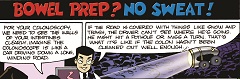
Comic Strip – How to prepare for a colonoscopy – Bowel Prep
Courtesy of Harpreet Pall, MD, St. Christopher’s Hospital for Children
What is a colonoscopy?
A colonoscopy is a procedure a gastroenterologist (doctor that deals with the gastrointestinal (GI) system) performs to examine the lining of the rectum, large intestine (colon), and part of the small intestine. This procedure will help your doctor better understand the underlying causes of GI symptoms.
The colonoscope is a narrow bendable tube about as thick as your index finger. It has a special digital camera and a light at the end and a hollow passage that goes through the entire length of the tube, through which the doctor can insert special instruments.
The colonoscope is gently inserted through the anus and slowly advanced into the rectum, colon, and end of the small intestine. It allows the doctor to view images on a video monitor. This procedure is also used to collect tiny samples of the inside lining of the intestine, called biopsies, or to perform other procedures such as removing growths on the intestinal lining called polyps.
Why might a child need a colonoscopy?
The most common reasons someone may need a colonoscopy are:
- Rectal bleeding or blood in the stools
- Unexplained change in bowel movements, such as having longstanding loose or watery stools (diarrhea)
- Longstanding unexplained belly or bottom pain
- Poor growth or unexplained weight loss
- In some infectious conditions
- To follow-up after a diagnosis of inflammatory bowel disease
- Fecal material infusion (fecal microbial transplant or FMT)
- Unexplained decrease in blood count from loss of iron (called iron deficiency anemia)
- Strong family history of certain polyps
- Abnormal imaging result, such as X-ray, MRI, or CT scan
What happens before a colonoscopy?
Bowel preparation
In the days before the test, your child will need to take an oral medicine to clean out all the stool from their intestines. This is called a “bowel prep” or a “colon cleanse”. Your doctor’s office will give you instructions on what medication to use and how to perform the bowel cleanse or prep. This is very important to help the doctor clearly see any abnormal areas in the intestinal lining. If there is formed stool in your colon, the doctor may not be able to complete the procedure successfully. Be sure to read all of the information provided very carefully.
For the clean-out to be effective, a large volume must be ingested over a relatively short period of time (your doctor will provide specific details). The end goal is to have clear watery diarrhea or stool that looks like urine. If it is difficult for your child to drink the oral medications (laxatives with and without stool softener), your doctor may suggest placement of a nasogastric tube. Placement of the tube requires your child to be admitted to the hospital before the procedure.
Diet
Your child will need to avoid solid food for at least one day before the test. They will also need to drink lots of clear fluids to make sure that they do not become dehydrated or dry on the day of the procedure. It is important that during this time they do not eat any solid food or drink any non-transparent liquids. It is also important to avoid red colored foods and drinks.
Fasting before the procedure
The colonoscopy will be performed after a period of complete fasting, except in emergency situations. The doctor’s sedation team will provide you with details of the length of fasting. For those older than 7 years, fasting is usually for 4–8 hours. Eating or drinking before the procedure would make it less safe to have the sedation/ anesthesia (sleeping medication) needed for the test.
Medications
Notify your doctor if your child is on any medications. Most medications can be taken right up to the day of the colonoscopy, but some medications may need to be stopped ahead of time. You will be given more detailed instructions on all of the above by your doctor or nurse.
On the day of the procedure
Before the test, the doctor will review the procedure with you and your child, including possible complications.
An IV will be inserted in your child’s hand or arm. Their blood pressure, heart rate, and breathing will be monitored before and during the test. For older females who have had their menstrual cycle, they will be requested to provide a urine sample for a pregnancy test.
What happens after a colonoscopy?
After the test, the doctor will tell you what was seen with the scope and may have pictures of your intestine to show your child. The biopsy result of the intestine usually comes later. Your child may pass gas intermittently after the procedure. The sooner they pass gas, the less likely they are to have cramping. Once your child wakes up and begins drinking liquids, your child can go home and start eating normally unless the doctor advises otherwise. If they feel sick after the test, they may be monitored until they feel better.
What are the risks of colonoscopies?
Colonoscopy is a safe procedure, but it does carry some minimal risks. Your child’s gastroenterologist will review these risks with you. In general, a colonoscopy is well tolerated and rarely causes significant pain. Your child may experience some pressure, bloating, or cramping during the procedure, depending on the type of sedation used.
However, there are some possible complications associated with a colonoscopy, including:
- A tear in the intestinal wall, called a perforation
- Excessive bleeding or infection
- A localized collection of blood outside the blood vessels, known as a hematoma
- Reactions or complications related to the sedation medications
If your child has a strong family history of certain conditions, this may also be relevant. Your child’s gastroenterologist will discuss these and any other risks specific to your child’s situation.
What should we watch for after the colonoscopy?
Your child may have a small amount of blood in their stool for a day or so after the procedure, which is normal. They may also experience some discomfort from gas remaining in the intestines after the test. This should improve over time as the gas is naturally passed.
When should we seek medical advice after the test?
You should call your pediatrician or go to the emergency department if your child has any of the following:
- Increased belly pain for more than an hour
- If your child’s belly becomes big and hard
- Bleeding from the rectum that is more than 2 tablespoons (30 mL)
- Bleeding for more than 2 days
- Fever or repeated vomiting
IMPORTANT REMINDER: This information from the North American Society for Pediatric Gastroenterology, Hepatology and Nutrition (NASPGHAN) is intended only to provide general educational information as a definitive basis for diagnosis or treatment in any particular case. It is very important that you consult your doctor about your specific condition.
Last reviewed and updated by: Fola Jose, MD. April 2019
Last edited by Priya Raj, MD, MS. June 2019